
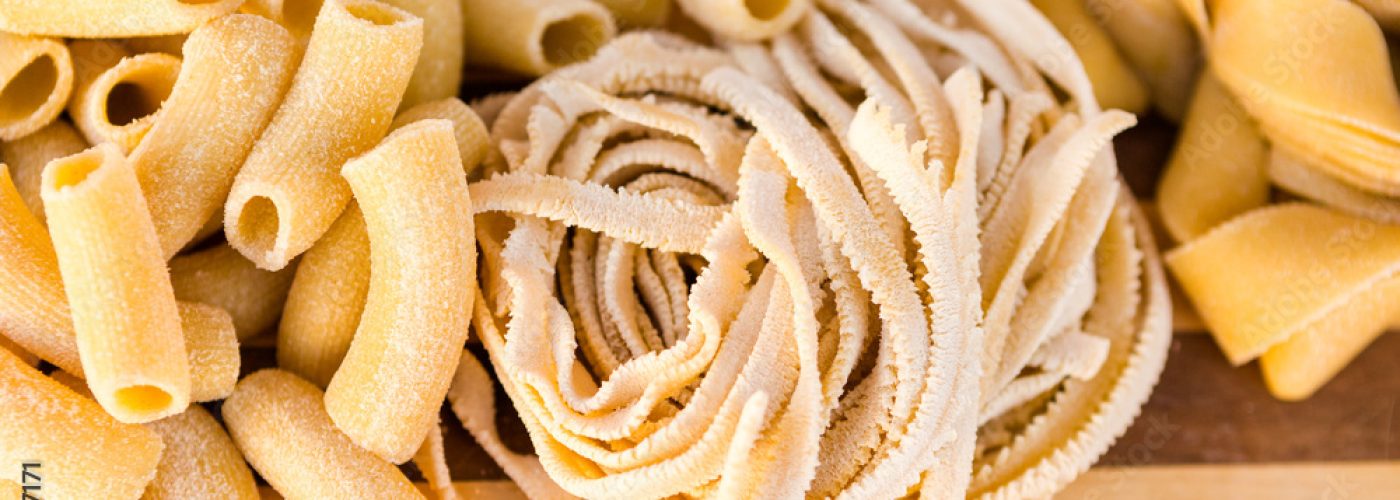
We Use Only the Finest Italian Semolina
At Pasta Lab, we use only imported Italian whole wheat semolina (semola integrale). We produce all our pastas in-house in our artisan facility. This yields an incredibly rich, robust, and nutrient-dense fresh pasta. Because whole wheat semolina retains the grain’s natural bran and germ, the production process requires precise hydration and handling to achieve a silky texture with a perfect bite.
Step One: Sifting and Hydration Management
The process begins by calculating the exact water-to-flour ratio. Whole wheat semolina is highly absorbent and requires slightly more hydration than highly refined Tipo 00 flour. The imported flour is checked for consistency and combined with purified water (and fresh eggs, depending on your recipe line).
Step Two: The Vacuum-Kneading Phase
In an artisan facility, the dough is mixed using specialized commercial mixers designed to replicate traditional hand-kneading mechanics.
- The Goal: Build a strong gluten network without overworking or heating the dough.
- The Process: Many high-end Italian artisan mixers use a vacuum system. Removing the air from the mixing chamber prevents the oxidation of the flour, preserving the rich, golden-brown color of the whole wheat and ensuring a dense, flawless dough structure.
Step Three: Low-Speed Bronze Extrusion
Once the dough forms a crumbly, playdough-like consistency, it is fed into the extruder. For true artisan quality, bronze dies are non-negotiable.
- Unlike smooth Teflon dies which create slippery, plastic-like noodles, bronze dies feature a microscopically rough texture.
- As the whole wheat dough is pressed through the bronze mold, it shears slightly, leaving a rough, porous, chalky surface matte finish. This rough exterior acts like Velcro, allowing heavy and light sauces alike to cling perfectly to the noodle.
Step Four: Precision Cutting and Blast Chilling
As the pasta leaves the die, it is cut cleanly to exact lengths—whether rolling into long tags for fettuccine nests or cutting short shapes like rigatoni.
- Because this is a fresh retail product rather than dried pasta, it bypasses the multi-day commercial drying rooms.
- Instead, it moves instantly onto mesh trays and passes through a commercial blast chiller or flash-pasteurizer unit. This rapidly drops the temperature and stabilizes the moisture level, locking in freshness, preserving color, and stopping the dough from sticking to itself in the packaging.
Step Five: Packaging
To give your fresh pasta a reliable shelf life for our farmers market pop-ups without adding artificial preservatives, the final step is packaging. The fresh whole wheat pasta is sealed in clear stay-fresh bags This keeps the fresh pasta pristine, elastic, and ready for the boiling pot.